- Where: Kaggle (Featured), $50,000 prize pool, medals awarded
- Task: Identify the 2D structure of unknown molecules from LC-MS/MS mass spectra
- Score: MRR@25 over up to 25 ranked candidates per molecule
- Dates: team merger 7 Dec 2026 · final deadline 14 Dec 2026
- Field: 5,305 teams on the public leaderboard (15 Nov); leader 0.549
- More: all Enveda CASMI 2026 facts, dates and FAQ
The short version
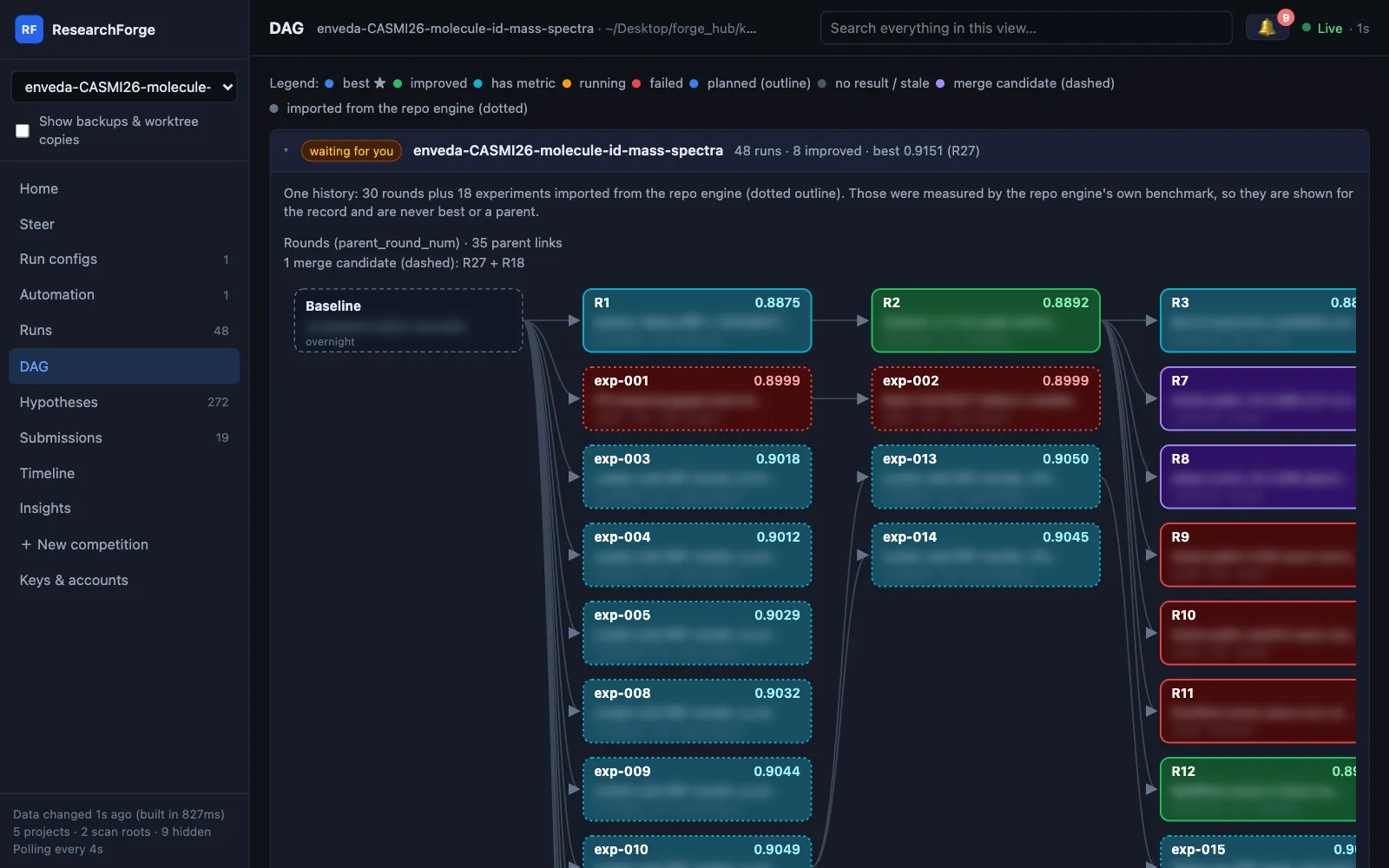
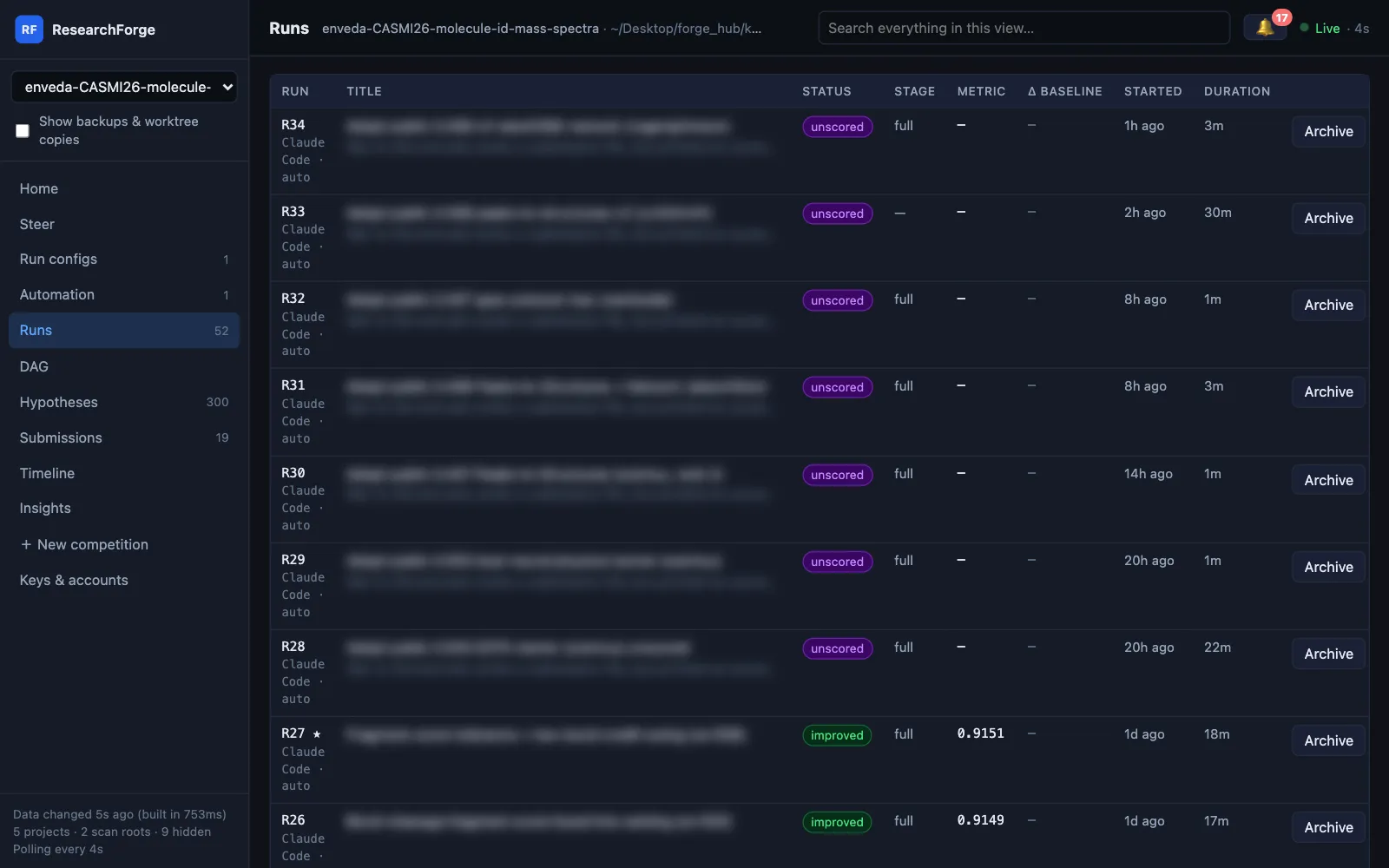
ResearchForge has recorded 52 rounds on Enveda CASMI 2026: 18 in October from the research loop and 34 since 7 November from Kaggle Overnight, all 34 launched unattended by auto-run with Claude Code as the driver. Our own ideas took the public score from 0.136 to 0.213. The jump to 0.479 came from adopting a public pipeline whose author reported 0.500. We say that plainly: the record exists to show what actually moved the score.
Score timeline (public leaderboard)
| Date | Local MRR@25 | Public | What changed |
|---|---|---|---|
| 24 Oct | 0.8994 | 0.136 | Spectral library search only |
| 25 Oct | 0.8994 | 0.156 | A fallback for molecules the library does not contain |
| 29 Oct | 0.9032 | 0.158 | A second ranking signal, from top public notebooks |
| 31 Oct | 0.8915 | 0.166 | Trusting the fallback more — local fell, public rose |
| 1 Nov | 0.8649 | 0.164 | Fallback only for ranks 2–25 — pushed too far |
| 11 Nov | 0.9115 | 0.181 | A different library similarity; both rose together |
| 13 Nov | 0.9141 | 0.191 | Spectrum clean-up before matching |
| 13 Nov | 0.9149 | 0.213 | A fragment-based score in the ranking — our own best |
| 13 Nov | — | 0.479 | A public pipeline adopted whole (reported 0.500) |
The October and November local numbers come from two different benchmarks, so compare them within each month, not across.
What worked
- ▸A better library similarity. The single biggest step of our own: local 0.895 → 0.912 and public 0.166 → 0.181.
- ▸Cleaning the spectrum before matching, then a fragment-based score on top: public 0.180 → 0.191 → 0.213.
- ▸Building on strong public work. The largest gain by far, and the reason we are near the bronze line.
- ▸Running unattended. Auto-run launched every November round on its own, so the loop kept going overnight and through the day.
What failed or was rejected, and why
| Round | Why it did not count |
|---|---|
| Fallback-only ranking (1 Nov) | Local 0.865 and public 0.164 — both down; rejected |
| Top-2 spectrum aggregation | Local 0.894 → 0.873; not kept |
| Two gated variants | Local 0.913 → 0.909; not kept |
| Two long rounds | Still running on Kaggle when the 30-minute round limit hit; collected when they finish |
| Two rounds with no metric, one timeout | Finished without a score, or timed out — not counted as results |
| 10 adopted public pipelines | Ran to the end with no local score; marked unscored, only the leaderboard can judge them |
The lessons
A local benchmark is only as good as what it holds out. In October ours held out spectra of compounds already in the library, so it could not see the fallback for unknown molecules, and the public score rose while local MRR@25 fell four times in a row. In November local and public moved together in five of seven steps. The full analysis is in Kaggle CV vs leaderboard.
Read the direction, not the size. A 0.0008 local gain came with +0.022 public, while two other sub-0.001 steps were ties. And a reported score is one draw: the pipeline reported at 0.500 scored 0.479 for us.
What’s next
Closing the 0.008 to the bronze line before 14 December, by combining the public pipeline with the ideas that held up on our own. Every round, kept or rejected, will be in the same record. See all four runs in our November standings, or run the loop on your own competition with Kaggle Overnight.