Competition runs

Real competitions. Failures included.

Four Kaggle competitions we are running ResearchForge on, in the open: the public rank, where it sits against the medal lines, the scores, and what the record taught us — including the ideas that looked good and were rejected.

Public Kaggle leaderboard · 15 Nov 2026

ARC Prize 2026 — ARC-AGI-3

Submissions closed 2 Nov · results 4 Dec
313 / 4,926 teams

Top 6.4% on the public leaderboard

🥉 Bronze-medal range

Rank 313 is inside the bronze-medal range on the public leaderboard (top 10% is rank 492 or better) and 0.46 below the silver line at 32.97. Medals are decided on the hidden games on 4 Dec, so this can still move.

Best public score
32.51
Leader
75.56
First public score
0.08
Experiments on record
14
Rejected, with reasons
10

From a first score of 0.08 to 32.51. The record shows what really moved it — and the 10 ideas that did not.

What the record showed

Two ideas that scored higher on our offline benchmark did worse on the hidden games. Both were rejected on the evidence, not kept on a hunch.

AgentsQwen3.8LoRA fine-tuneOffline proxy vs leaderboard
Gemma 4 Developer Agent

Live · closes 2 Dec
2,292 / 5,772 teams

Top 39.7% on the public leaderboard

Bronze line 0.20

The bronze-medal line is 0.20, three tasks in a hundred above our 0.17. Of 24 recorded rounds, 20 failed, most of them on Colab compute rather than on the idea — that is the next thing to fix.

Best public score
0.17
Leader
0.29

A byte-identical resubmission scored 0.12, then 0.17 — so no single leaderboard number is trusted.

What the record showed

Resubmitting identical code moved the public score by 0.05, so one leaderboard number is treated as noisy evidence, not a verdict.

Coding agentsGemma 4Leaderboard noise

Enveda CASMI 2026 — molecule ID from mass spectra

Live · closes 14 Dec
1,421 / 5,305 teams

Top 26.8% on the public leaderboard

0.008 from bronze

The bronze-medal line is 0.487 (rank 530); we are at 0.479, 0.008 below it, with a month left before the 14 Dec deadline.

Best public score
0.479
Leader
0.549
First public score
0.136
Experiments on record
52
Rejected, with reasons
10

From rank 3,856 (5 Nov) to 1,421 (15 Nov). Our own rounds took the public score from 0.166 to 0.213; adopting a stronger public pipeline took it to 0.479.

What the record showed

In October the public score rose while local MRR@25 fell. In November the two finally moved together (local 0.889 → 0.915, public 0.166 → 0.213). A public pipeline advertised at 0.500 scored 0.479 for us — the record keeps both numbers.

Mass spectrometryRetrievalCV vs leaderboard

Squares in Squares — pack 1 to 1,000 unit squares

Live · closes 18 Jul 2027
401 / 2,086 teams

Top 19.2% on the public leaderboard · lower score wins

Playground · no medals

Squares in Squares is a Playground competition, so it awards no Kaggle medals; the $50,000 prize pool still applies. Top 10% today is 22.1528; our newest local packing measures 22.1580 and is not submitted yet.

Best public score
22.1756
Leader
22.0400
Experiments on record
46
Rejected, with reasons
7

Public score from 22.2502 to 22.1756 in eight days, over 46 rounds. Almost every gain came from certified merges of public packings; our own search ideas have barely moved it yet.

What the record showed

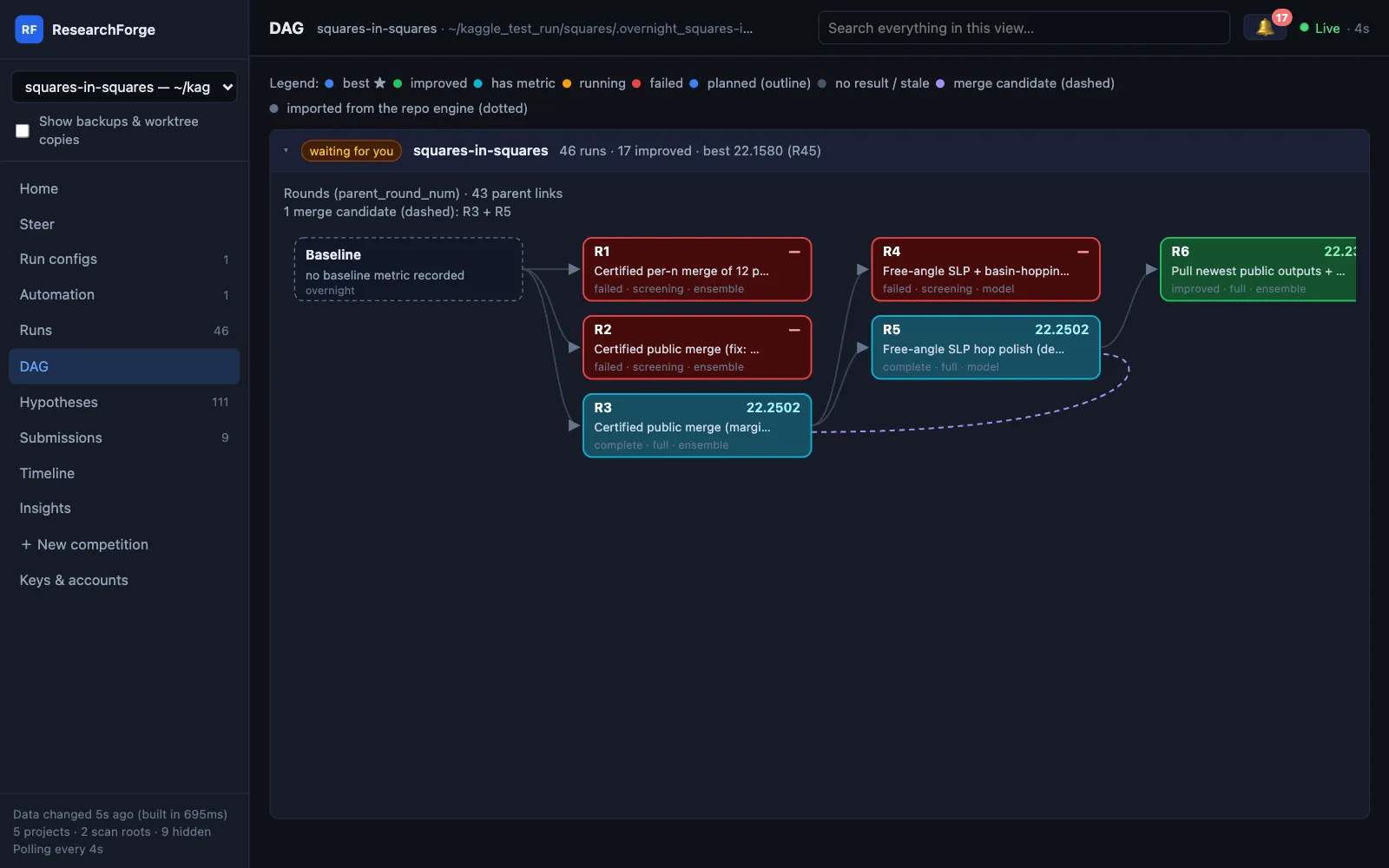
17 rounds improved the score; 16 were merges of public outputs, checked for overlap. Our own polishing, neighbour transfer and seed shapes ran 12 times for one gain of 0.0000015. The field moves daily, so a better score can still mean a lower rank.

OptimizationGeometryPublic-notebook merge

How the record works

Every number above comes from the same record you get.

Each experiment is measured against a frozen baseline and kept or rejected with a reason. Winners become parents, independent winners get merged, and the experiment tree on your local dashboard is the one shown here.

localhost:7842
Squares in Squares experiment tree in the ResearchForge dashboard
Squares in Squares — the experiment tree, as recorded

Used ResearchForge in a competition?

Send us the run — wins and rejections both — and we will feature it here.